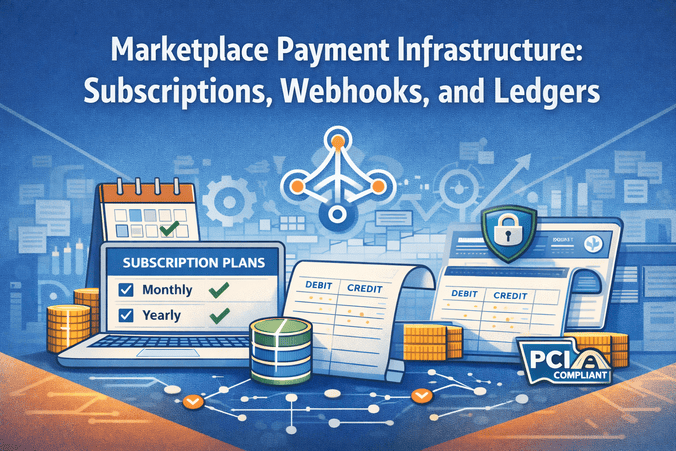
The Backbone of Commerce: Marketplace Payment Infrastructure
Building a UI for payments is easy; building the marketplace payment infrastructure that handles a million transactions without a single cent going missing is the true challenge. This post explores the three critical components of a world-class payment backend: Idempotency, Reliable Webhooks, and Immutable Ledgers.
1. The Idempotency Key Pattern
In the world of marketplace payment infrastructure, "at-least-once" delivery is the norm. This means you will receive the same payment request or webhook multiple times. Without idempotency, you will double-charge users or double-pay providers.
Implementation Strategy:
2. Reliable Webhook Processing at Scale
Webhooks are asynchronous events from your gateway (Stripe, Adyen, etc.). They are the only way to know if a subscription was renewed or a payment was disputed. Your marketplace payment infrastructure must treat webhooks as critical data.
The "Receiver-Worker" Pattern for Reliability:
3. The Double-Entry Ledger: Why SQL Isn't Enough
A simple "balance" column on a user table is a recipe for disaster. You cannot "undo" a balance update if a crash happens midway through a transaction. A **Double-Entry Ledger** provides an immutable audit trail. Every movement of money is a transaction consisting of at least two entries (one debit, one credit) that must balance to zero.
Example: Releasing a $100 Escrow to a Provider (10% Fee)
Transaction: RELEASE_MILESTONE_123
- Entry 1: Account (EscrowHold), Direction (DEBIT), Amount ($100)
- Entry 2: Account (ProviderBalance), Direction (CREDIT), Amount ($90)
- Entry 3: Account (PlatformRevenue), Direction (CREDIT), Amount ($10)
This allows you to perform "Reconciliation"—comparing your ledger against the bank's statement to ensure every cent is accounted for.
4. Subscription Billing: Separating Plans from Entitlements
A major pitfall in marketplace payment infrastructure is hardcoding logic like if (user.plan === 'PRO'). Instead, use an **Entitlements Layer**. A subscription purchase grants a set of "Entitlements" (e.g., can_message_unlimited: true, max_listings: 50). Your application code checks for the entitlement, not the plan. This allows you to change what's included in a plan, or offer custom enterprise plans, without refactoring your codebase.
5. Preparing for Scaling Failures
As you grow, your payment system will face "High Contention." For example, if a popular seller has 1,000 buyers paying them at once, your ledger table might experience row-locking issues on that seller's account. Scaling Strategies:
Conclusion: Payments Are a Product
Investing in robust marketplace payment infrastructure isn't just a technical task; it's a strategic advantage. A system that is reliable, idempotent, and perfectly auditable builds the trust necessary to attract high-value enterprise users. To learn more about the strategic side, explore our guides on enterprise payment systems and escrow engineering.

Leave a Comment