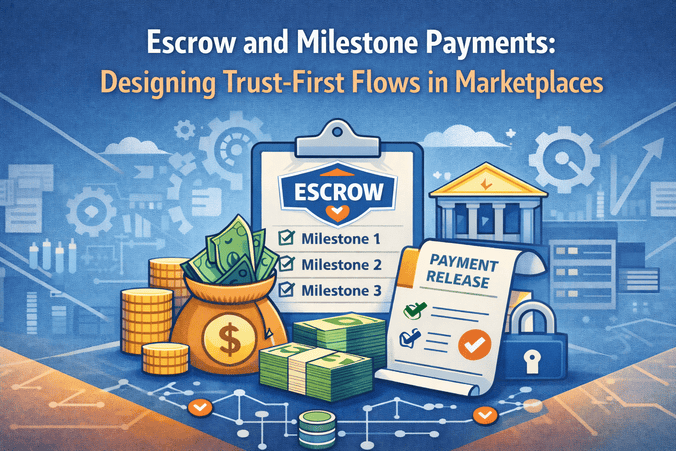
The Trust Layer: Why Escrow Is Non-Negotiable
In a service marketplace, the transaction isn't the end; it's the beginning of a commitment. Escrow and milestone payments are the technical solution to the "Principal-Agent Problem." The buyer wants proof of work before losing funds; the provider wants proof of funds before starting work. An enterprise-grade escrow system solves this by acting as a programmatic mediator.
The Escrow State Machine
Designing escrow and milestone payments requires a strict state machine. Funds must move through a series of "locked" states where reversals and releases are strictly governed by business rules.
Technical Lifecycle of a Milestone:
Engineering for Atomic Fund Releases
The most critical failure in an escrow system is the "Double Release" or "Orphaned Fund." This happens when multiple requests or retries attempt to trigger a release simultaneously. To prevent this, you must use **Atomic Database Transactions**. When a release is triggered:
The Fee Calculation Logic
Fees in escrow and milestone payments should be calculated at the **moment of release**, not the moment of funding. Why? Because the fee structure might change based on external factors during the project (e.g., a dispute resolution fee, or a volume-based discount that was triggered mid-project). Calculating at release ensures that the ledger reflects the most accurate financial state.
Handling Partial Refunds and Adjustments
What happens if a $1,000 milestone is only 50% completed? Your system must support "Partial Escrow Reversals." This requires recalculating the platform fee proportionally. If you take a 10% fee, a $500 refund to the buyer means the platform "returns" $50 of its pending revenue and the provider "loses" $450 of their pending earnings. Your ledger must account for these partial movements without losing the "audit trail" of the original $1,000 intent.
Dispute Handling: The "Freeze" Pattern
A dispute is essentially a state where funds are "unauthorized" for release but "unvailable" for refund. In your ledger, these should move to a specific DisputedFunds account. This keeps the money out of the EscrowHold pool (which is used for liquidity reporting) and ensures it cannot be touched by automated payout scripts until the dispute status is manually resolved by an admin.
Race Conditions and Safeguards
At high scale, "Race Conditions" can occur between a Buyer clicking "Release" and an Admin clicking "Refund" at the same microsecond. An enterprise-grade system uses **Optimistic Concurrency Control** (using a version column) or **Pessimistic Locking**. If the version has changed since the page was loaded, the second operation must fail gracefully with a "Conflict" error.
Conclusion: Building for Reliability
Designing robust escrow and milestone payments isn't just about moving money—it's about managing a complex set of promises. By using a strict state machine, atomic transactions, and a deferred fee model, you can build a marketplace that users trust with their most valuable projects. For more on the underlying architecture, see our guide on enterprise payment systems and infrastructure reliability.

Leave a Comment