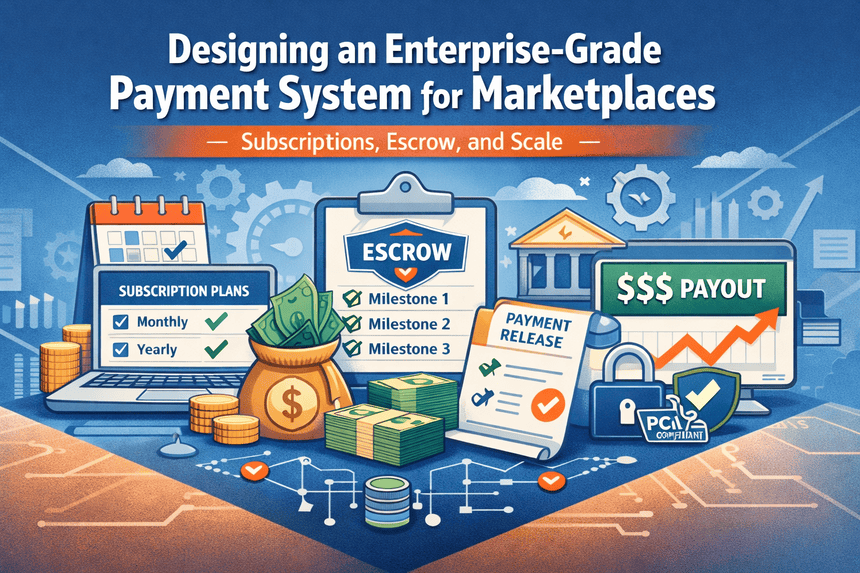
The Architectural Challenge: Why Payments Are the Hardest Part of Marketplaces
In a marketplace, you aren't just selling a product; you are facilitating a complex, multi-party financial transaction. Building an enterprise-grade payment system for marketplaces requires solving for "n-sided" money flows where trust, timing, and transparency are paramount. Unlike a simple e-commerce site, marketplace payments involve split payments, deferred payouts, and regulatory complexity (KYC/AML).
Many engineering teams fall into the trap of "Stripe Coupling"—where business logic is scattered across various gateway-specific webhooks and metadata fields. This creates a fragile system that is impossible to audit or migrate. An enterprise-grade architecture demands a clean separation between the **External Gateway** and your **Internal Payment Domain**.
1. The Internal Abstraction Layer: Your Financial Source of Truth
The core of an enterprise-grade payment system for marketplaces is an internal abstraction layer. This layer treats the external gateway (Stripe, Adyen, etc.) as a "dumb" execution engine. Your internal system should manage:
Core Architecture: The Three Pillars
Pillar 1: The Double-Entry Ledger System
A "payments" table is not a financial system. To be enterprise-ready, you must implement a **Double-Entry Ledger**. This is the non-negotiable standard for any system handling other people's money. In this model, every movement of value results in at least two entries: a debit from one account and a credit to another. The sum of all entries in a transaction must always equal zero.
Technical Schema Blueprint:
Accounts Table:
- id: UUID
- type: (LIABILITY, ASSET, REVENUE, EXPENSE)
- owner_id: UUID (User, Platform, or Escrow)

Transactions Table:
- id: UUID
- reference_id: String (The business event ID)
- timestamp: DateTime

Entries Table:
- id: UUID
- transaction_id: UUID
- account_id: UUID
- amount: Decimal
- direction: (DEBIT | CREDIT)
This allows for "Snapshot Auditing"—where you can prove the exact balance of any user at any point in history by summing their ledger entries.
Pillar 2: The Idempotency Engine
In a distributed system, network failures are inevitable. A "timeout" during a payment call doesn't mean the payment failed—it means you don't know the result. An enterprise-grade system uses **Idempotency Keys** (usually a V4 UUID) for every destructive operation. Your backend must check if a key has been processed before executing logic, returning the cached result for subsequent identical requests. This prevents "Double Charging" during client-side retries or webhook replays.
Pillar 3: The Asynchronous Webhook Processor
Never process business logic (like updating a ledger or sending an email) directly in the webhook route. Use a "Receiver-Worker" pattern:
Payment Models at Scale
An enterprise-grade payment system for marketplaces must handle overlapping models simultaneously:
Security Boundaries and Compliance
To achieve **PCI DSS Compliance** with minimal overhead, your architecture must ensure sensitive data (Credit Card Numbers, CVVs) never touches your servers. Use **Tokenization** or **Hosted Payment Pages**. Your system should only store a payment_method_token which is useless if stolen but allows you to initiate future charges.
Scaling and Failure Points
What breaks first at scale? 1. **Database Contention**: High-frequency ledger writes on a single "Platform Account" can cause locking issues. Solution: Shard your ledger or use an append-only log model. 2. **Webhook Storms**: After a gateway outage, you might receive 100,000 webhooks in minutes. Solution: Rate-limit your queue workers and use a "Dead Letter Queue" (DLQ) for failed events.
Final Takeaway
Payments are a product, not a feature. Investing in an enterprise-grade payment system for marketplaces early—centered around a double-entry ledger and a robust abstraction layer—is the difference between a scalable business and an operational nightmare. For technical deep dives, explore our guides on escrow engineering and infrastructure reliability.

Leave a Comment