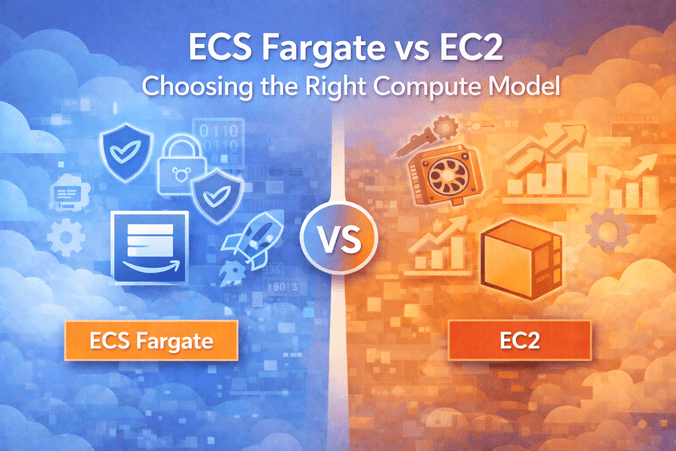
The Compute Crossroad: ECS Fargate vs EC2
When deploying containers on AWS, the first big decision is always: ECS Fargate vs EC2. Should you manage the underlying virtual machines yourself, or let AWS handle the infrastructure? This choice impacts your operational overhead, cost structure, and security posture.
In this guide, we'll break down the nuances of ECS Fargate vs EC2 to help you decide which model fits your specific needs in 2026.
What is ECS Fargate? (The Serverless Approach)
Fargate is a serverless compute engine for containers. You don't see or manage servers. You specify your CPU and memory needs, and AWS provisions the compute on-demand. In the ECS Fargate vs EC2 debate, Fargate is the "managed" option.
- No Patching: AWS manages the OS and runtime security.
- True Scaling: Scale the number of containers without worrying about cluster capacity.
- Pay-per-use: Billed based on the CPU/Memory resources requested by your tasks.
What is ECS on EC2? (The Infrastructure Approach)
Choosing EC2 means you manage the cluster capacity. You own the instances. You are responsible for patching the underlying OS and scaling the cluster itself before you can scale your containers.
- Full Control: Choose specific instance types (GPU, High Memory, etc.).
- Cost Optimization: Potential savings with Reserved Instances or Savings Plans.
- Custom Runtimes: If you need specific kernel configurations or drivers.
Key Comparison: ECS Fargate vs EC2
| Feature | ECS Fargate | ECS on EC2 |
|---|---|---|
| Management | Zero (Serverless) | High (Manage Instances) |
| Cost Model | Pay-per-task | Pay-per-instance |
| Security Isolation | Kernel-level per task | Instance-level |
| Scaling Speed | Fast (On-demand) | Slower (Cluster must scale first) |
| GPU Support | Limited | Standard |
When to Choose Fargate
Fargate is the gold standard for most modern web applications. If your primary goal is speed to market and minimal operations, ECS Fargate vs EC2 is an easy win for Fargate.
- Short-lived or bursty workloads.
- Small to medium engineering teams without dedicated DevOps.
- High-security requirements (automatic patching).
When to Choose EC2
EC2 still has its place, particularly at massive scale. If you are running thousands of tasks 24/7, the ECS Fargate vs EC2 cost calculation might tilt toward EC2.
- Consistent, predictable high-volume traffic.
- Workloads requiring GPUs or specific local storage performance.
- Legacy apps that require root access to the underlying host.
The "Best of Both Worlds" Strategy
Modern architects don't just pick one. They use Fargate for the web/API tier for agility and EC2 for heavy data processing jobs or ML training where cost/performance tuning is critical. AWS allows you to mix and match both within the same ECS cluster using Capacity Providers.
Real-World Mistake: The Over-Provisioned Cluster
"We chose EC2 to save money, but we ended up paying for 40% idle capacity because we couldn't scale the cluster down fast enough."
— DevOps Lead at a Series B StartupThis is the hidden cost of EC2. Unless you are an expert at Auto Scaling Groups, Fargate often ends up being cheaper because you only pay for what you actually use.
Final Verdict: ECS Fargate vs EC2
For 90% of TechStream's clients, we recommend Fargate. The "peace of mind" of not managing servers far outweighs the small price premium. Move to EC2 only when you have a specific technical or financial constraint that Fargate cannot meet.
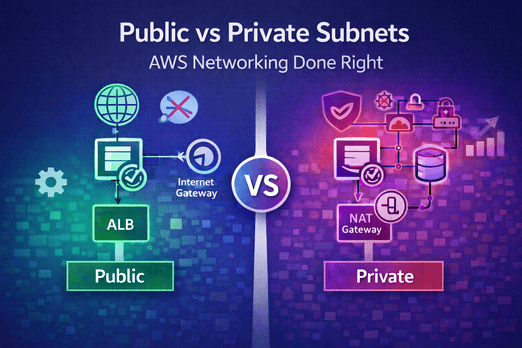
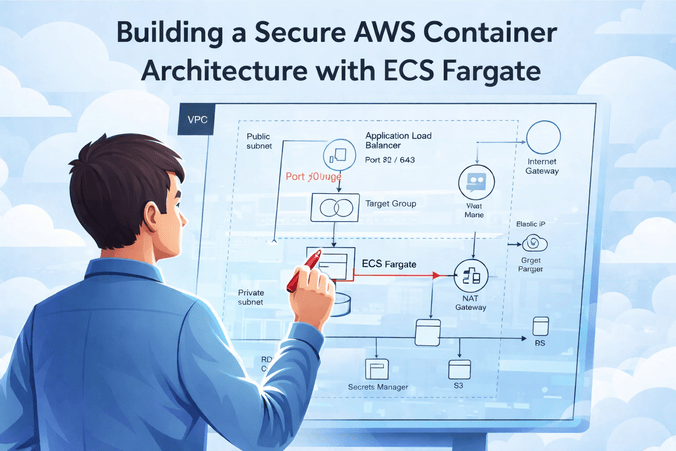
Ready to build? See our Step-by-Step Guide to Fargate Architecture or learn about Scaling with Public and Private Subnets.

Leave a Comment