The Real Shift Isn’t “Chatbots”
In 2026, the tech world has finally moved past the "chatbot hype." While most people still talk about Retrieval-Augmented Generation like it's just a feature for customer support, the bigger shift is much more fundamental. RAG in 2026 is not about adding a chat box; it's about a complete re-engineering of how users interact with data.
Legacy engagement was built on engineers predicting what users want and pushing content. In contrast, RAG engagement allows users to ask anything, and the system pulls the best answer in real time. This fundamental shift changes architecture, data flow, UX, and even team roles.
"We used to optimize for minutes spent in the app. Now, we optimize for seconds taken to solve a problem."
— Lead Product Engineer, TechStreamUser Intent: Legacy Search vs. RAG Resolution
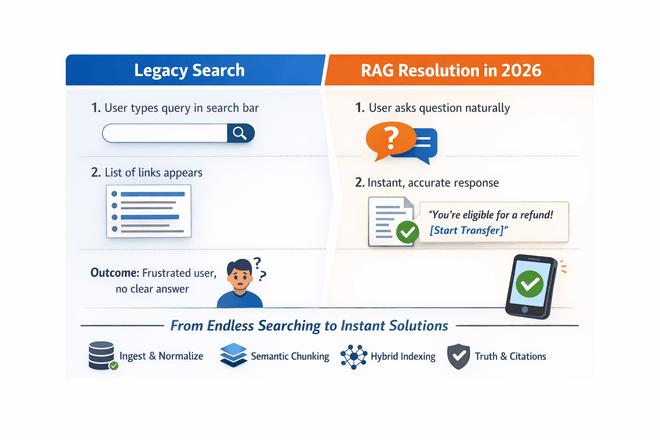
To understand the power of RAG in 2026, let's look at how a simple user query is handled differently across generations of tech.
Scenario: "What is the refund policy for a damaged gift card in India?"
Legacy Engagement (Push)
Step 1: User types query in search bar.
Step 2: System shows a list of 10 links matching "refund" and "gift card".
Outcome: User leaves frustrated or opens a support ticket finding nothing specific.
RAG Engagement (Pull)
Step 1: User asks the question naturally.
Step 2: System finds Section 4.2 and confirms bank transfer refunds for damaged cards.
Outcome: "Yes, for damaged cards in India, you are eligible for a refund. [Click here to start transfer]"
Building a Resolution-First Implementation
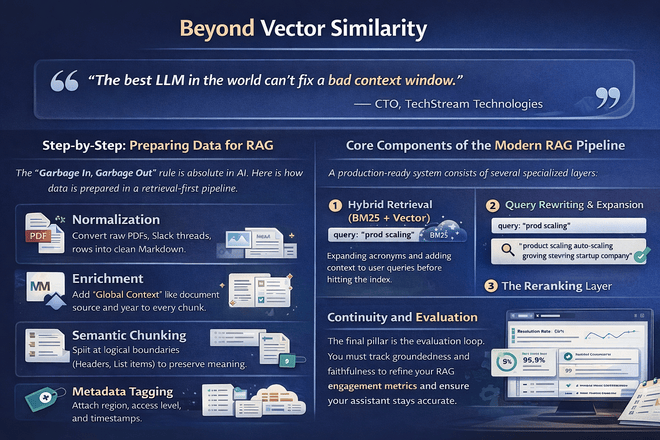
Implementing RAG in 2026 requires a modern retrieval-first pipeline. A production-grade system involves:
- Ingestion & Normalization: Standardizing content from all sources into a unified schema.
- Semantic Chunking: Moving to meaning-aware sections that preserve context.
- Hybrid Indexing: Combining vector similarity with BM25 keyword search for SKUs and error codes.
For a deeper dive into the technical stack, see our guide on modern RAG architecture.
The Engineering Checklist for 2026
Ultimately, RAG in 2026 is about trust. The work has changed from "what to show next" to "what to answer correctly now."
Leave a Comment