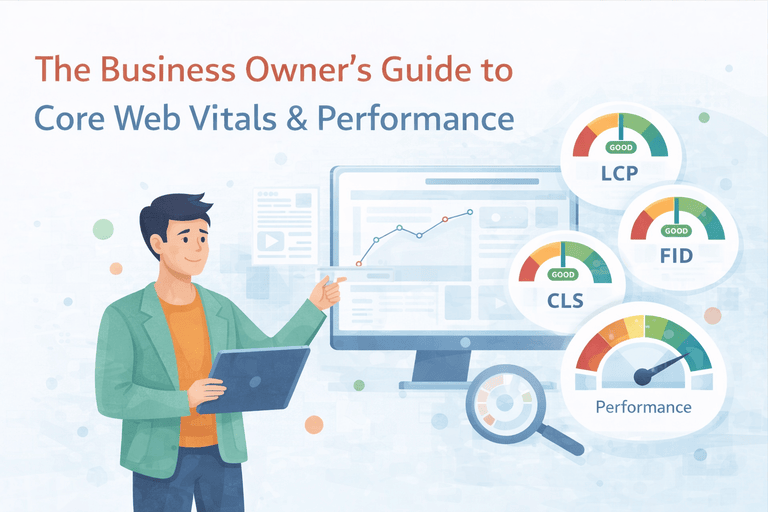
Google speaks a language called "Core Web Vitals." As a business owner, you don't need to be a developer to understand them, but you do need to know that they directly impact your bottom line. Since 2021, these metrics have been an official, major ranking factor.
If your website fails these tests, Google will effectively penalize your rankings, pushing you onto Page 2 or 3 where nobody looks.
The Three Pillars of User Experience
Google breaks down "user experience" into three specific, measurable metrics:
1. Largest Contentful Paint (LCP) - "Loading Speed"
In simple terms: How long does it take for the main thing on the screen (usually the hero image or headline) to actually show up?
- Good: Under 2.5 seconds
- Needs Improvement: 2.5s to 4.0s
- Poor: Over 4.0 seconds
Business Impact: If users stare at a blank screen, they leave. It's that simple.
2. Interaction to Next Paint (INP) - "Responsiveness"
(Note: Looking for FID? INP replaced FID as the standard in March 2024.)
In simple terms: When a user clicks "Add to Cart" or opens the menu, how quickly does the site react? Does it freeze up?
- Good: Under 200 milliseconds
- Poor: Over 500 milliseconds
Business Impact: A "frozen" site feels broken. Users rage-click or abandon their cart entirely.
3. Cumulative Layout Shift (CLS) - "Visual Stability"
In simple terms: Does the page jump around as it loads? We've all experienced trying to read an article when suddenly an ad loads and pushes the text down 3 inches.
Business Impact: It's incredibly frustrating and causes accidental clicks (often on ads or "Cancel" buttons), destroying user trust.
How to Check Your Score
You don't need to guess. Go to PageSpeed Insights and enter your URL. It will give you a pass/fail grade for real-world user data.
"The probability of bounce increases 32% as page load time goes from 1 second to 3 seconds."
The Bottom Line
Passing these checks often requires technical optimization: lazy loading images, optimizing server response times, and minimizing main-thread work. It's the difference between a "good enough" site and a high-performance digital asset that ranks #1.

Leave a Comment